
Read Along with Us: The Barker Book Club
The Barker Book Club meets four to five times annually to discuss adoption-related titles. Staff from across the organization—from Finance to Post-Adoption—come together to read books that deepen our understanding of adoption, identity, and family. We intentionally select titles that are meaningful to our work and potentially meaningful to those we serve, with an emphasis on lifting the voices of adopted persons, alongside works by birth and adoptive parents.
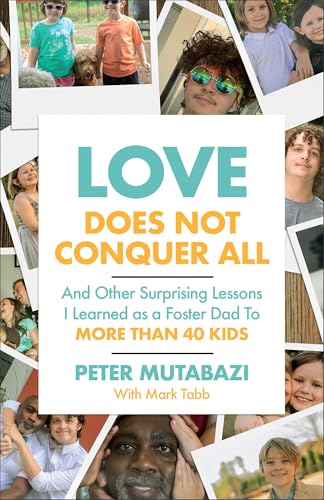
February 2026 Pick: Love Does Not Conquer All by Peter Mutabazi with Mark Tabb (2022)
Rating: Recommended[1]: Offers meaningful, respectful insights into adoption themes.
Recommended for: Adoptive Parents, Adoption Professionals and anyone connected to a family formed through adoption, especially adoption from foster care. Adopted Persons and Birth/First Parents will also find this work empathic, and reflective of a range of experiences.
Content Note: Love Does Not Conquer All addresses childhood trauma, abuse, and neglect, as well as the challenges of foster and adoptive parenting. Themes include grief, loss, behavioral struggles, and the emotional toll on both children and caregivers. The author writes from a Christian faith perspective; however, religious references are presented in an invitational and philosophical manner that many readers may find accessible regardless of faith background.
Review
Peter Mutabazi and Mark Tabb’s Love Does Not Conquer All: And Other Surprising Lessons I Learned as a Foster Dad to More Than 40 Kids, sparked rich and thoughtful discussion among our Book Club participants. Every reader described it as essential reading for families considering adoption from foster care. The tone is warm and deeply human, yet the stories are candid regarding the realities of trauma, and parenting children who have experienced profound adversity. While some participants found the audiobook narrator less engaging, those who listened remained invested, noting that the strength of prose and storytelling carried them through.
The Limits of Love Alone
A central message of the book is captured in one of Mutabazi’s most memorable lines: “Love doesn’t conquer, it triggers.” Love, while essential, is not a cure-all for trauma. Instead, love can surface grief, fear, and mistrust for children who have never or inconsistently experienced safe, consistent care.
Mutabazi challenges caregivers to understand that connection may at first feel threatening to a child raised in environments full of instability. Rather than personalizing rejection or resistance, parents are invited to see behavior through a trauma-informed lens. Love is critical and foundational, but must be accompanied by patience, structure, and deep self-awareness.
Raising the Child in Front of You
Repeated throughout the book is the guiding principle: “Raise the child based on who they are, not who you want them to be.”
Mutabazi emphasizes that parenting children from foster care requires flexibility and humility. Each child’s history is uniquely painful and complex. Expectations rooted in fantasy around gratitude, bonding, or quick adjustment must be replaced by curiosity about the individual child’s needs, pace, and personality.
Our Book Club members appreciated his consistent reminder that growth and adjustment primarily rest with the adult. Adoptive and foster parents make a conscious, prepared decision to step into the role; children do not. The responsibility for reflection, learning, and change therefore lies with the person who had agency: the parent.
Trust Is Built Brick by Brick
One analogy that resonated deeply with our group is Mutabazi’s “bridge” metaphor. For biological children, he suggests, unconditional love begins building a bridge from birth. For children entering foster or adoptive homes, that bridge must be constructed later, brick by brick, through consistent actions over time.
Adults can invite a child toward connection, but the child determines whether and when to cross this metaphorical bridge. This framing underscores how extraordinarily difficult it is for a child to trust when no foundation for trust exists, and how much patience that process demands of caregivers.
Empathy Rooted in Lived Experience
Mutabazi’s own childhood—marked by abuse, poverty, and time spent on the streets—shapes his remarkable capacity for empathy. He draws on both his early experiences and his time in a supportive “pseudo foster family” to illustrate how transformative safe, steady adults can be.
Readers were especially struck by his humility and curiosity. He openly reflects on his own mistakes and demonstrates a willingness to improve. The stories reflect a diversity of children and circumstances, while modeling the environment of trust that consistent caregiving can create.
A Tone of Invitation, Not Judgment
Despite tackling heavy themes, the book maintains a conversational, non-judgmental tone. While some ideas are revisited multiple times, participants found the repetition purposeful and reinforcing. Mutabazi himself parents from a faith perspective, yet his reflections are framed philosophically and invitationally rather than prescriptively, allowing readers of varied backgrounds to remain engaged.
Ultimately, Love Does Not Conquer All invites caregivers to shift their mindset: from fixing behaviors to understanding their roots, from expecting gratitude to building trust, and from relying on love as a feeling to demonstrating love as consistent action. For families considering adoption from foster care—and for the professionals who support them—it offers both sobering realism and grounded hope.
Read Along with Us!
In April 2026, the Barker Book Club will gather to discuss Far from the Tree, by Robin Benway.
Until then—happy reading!
- The Barker Book Club
[1] The Barker rating system does not label books as “good” or “bad.” Instead, it evaluates how honestly a work engages with core adoption themes and portrays the experiences of the adoption triad, as well as its relevance to the adoption community.